



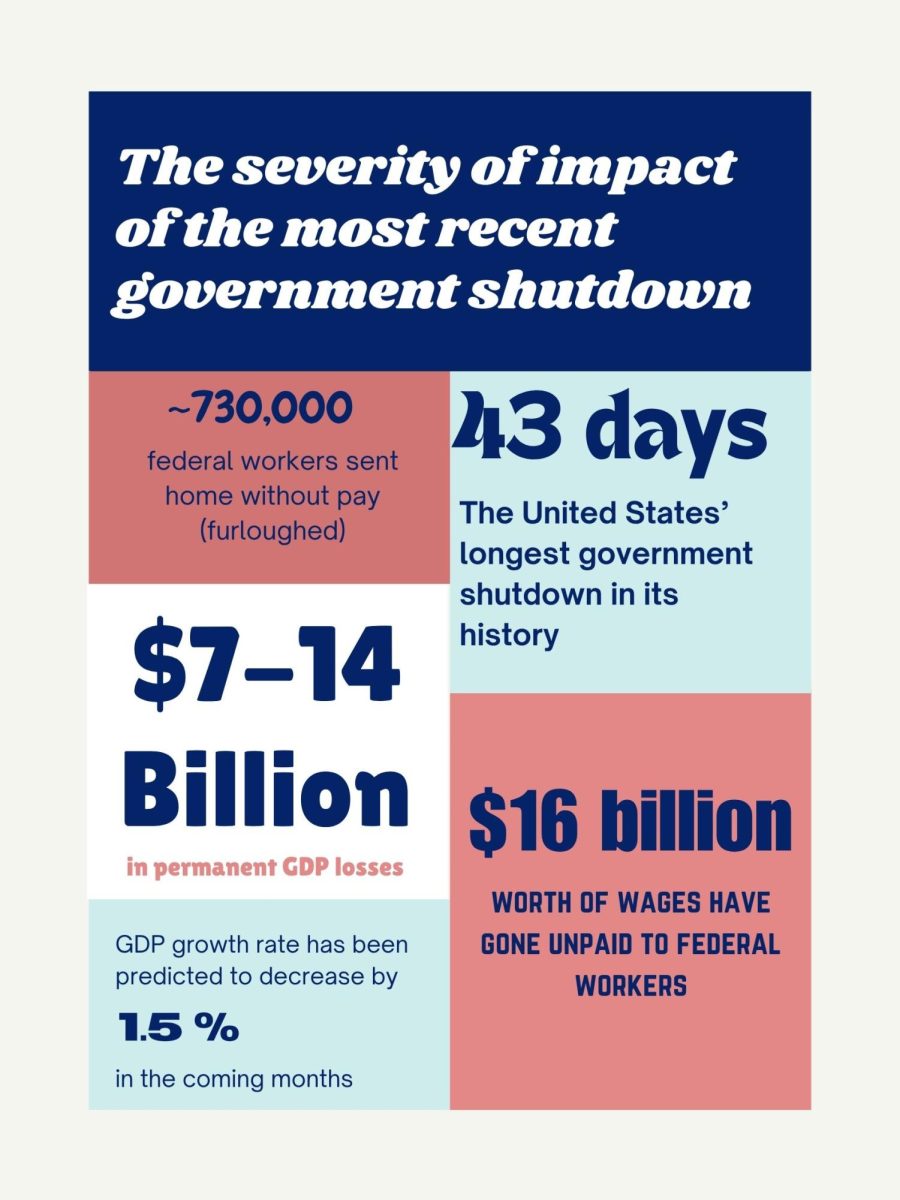
On Oct. 1, 2025, government issues and conflicts in Washington led to a shutdown that temporarily stopped funding for a wide range of federal programs. Agencies like the Federal Aviation Administration (FAA), the National Institutes of Health (NIH), and food programs like SNAP and public school meal programs were forced to pause or limit their services. The shutdown affected many American families, including those in the Mater Dei community, who rely on these programs or have relatives working in federal jobs.
During the shutdown, many federal workers were furloughed, or required to work without pay. According to U.S Congresswoman Lateefah Simon’s website, the temporary shutdown has disrupted the operations of facilities such as veterans’ medical facilities, federal office buildings, and ports, including seaports, airports, etc.
“The following federal facilities may be affected in the event of a government shutdown: Military bases, arsenals, depots, and federal armories, Veterans’ Affairs medical facilities, ports including seaports, airports, IRS facilities, Law enforcement agencies like the FBI, ATF, DEA, or CBP, [and] General federal office buildings,” the site states.
For Mater Dei families who have relatives or family members who work or are benefited by government programs, and others have been affected by pay, canceled flights, and the ability to help those in need. Students are aware of the effects, including sophomore Stella Feldman, whose family works to feed those less fortunate.
“I know that the shutdown [affected] hundreds of people, and people are going days without food and weeks without a paycheck,” Feldman said.
Feldman and her family noticed that the government resources that had become unavailable affected their ability to provide homeless families with food, such as sandwiches.
“My family spends a lot of time making PB&J for the homeless,” Feldman said. “I started noticing [the effects] when my parents were talking about how they ran out of food for their patients and had no way to get more food.”
Senior Preston Vu and his family have been struggling with flight cancellations and delays. Vu noticed the shortage of staff in airport facilities, as there were fewer employees at the Transportation Security Administration (TSA) screening areas.
“One example was when I was at the airport on a trip, I saw that at TSA [security checkpoints], there were a lot fewer [employees],” Vu said. “And I later learned that they weren’t even being paid at that moment, they were promised to be paid later.”
Lasting 43 days, the recent government shutdown was recorded as the longest in U.S. history. In mid-November, Congress passed a temporary bill to fund the government. Government programs are now running and workers are getting paid fairly, including Monarch families. Those who rely on alternative forms of payment, such as EBT and food stamps, are also able to use their programs. In the aftermath, nonprofit organizations and local groups have stepped in to help families recover from the disruption, demonstrating how communities can come together to support their communities.
![BUILDING THE FUTURE: Plans to build tennis courts and a new Performing Arts Center will be started and completed in the coming years. This will benefit students and athletes alike as they will enhance both the Athletic and Performing Arts Departments and bring much-needed venues and state-of-the-art spaces to campus. “You want to be rooted in that tradition of the school when [it comes to] these projects, we’ve always got to be innovating and moving forward,” Vice President of School Relations Scott Melvin said. Mock Renderings courtesy of Mater Dei High School.](https://thescarletscroll.com/wp-content/uploads/2026/06/Mater-Dei-Tennis-Court-and-PAC-e1780632956112-1200x672.jpg)




![GET UP Students laugh and dance at a school rally. All the events and rallies hosted by ASB help bring students together and make school an enjoyable place to be. Senior Maddy O’Connor believes ASB keeps everything together and the school spirit alive. “A lot of things wouldn't be as organized [without ASB] and it'd be kind of boring,” O’Connor said. “ASB brings joy to Mater Dei, and pretty much [all things] cool.”](https://thescarletscroll.com/wp-content/uploads/2026/05/HEIF-Image-1200x800.jpeg)

![OUT OF THE PARK Sophomore Ally Roman takes a swing during her sixth game of the spring season. On Wednesday, Mar. 18, the JV softball team faced Villa Park in a tough matchup. “ I've made a lot [of sacrifices for softball],” senior Savanah Duncan said. “It takes up a lot of time, especially playing at a high level. I would say you have to sacrifice a lot of your time and a lot of outside activities, because a lot of time is just spent on the softball field.”Photo courtesy of Ali DePhillips.](https://thescarletscroll.com/wp-content/uploads/2026/04/HEIF-Image-10-800x1200.jpeg)