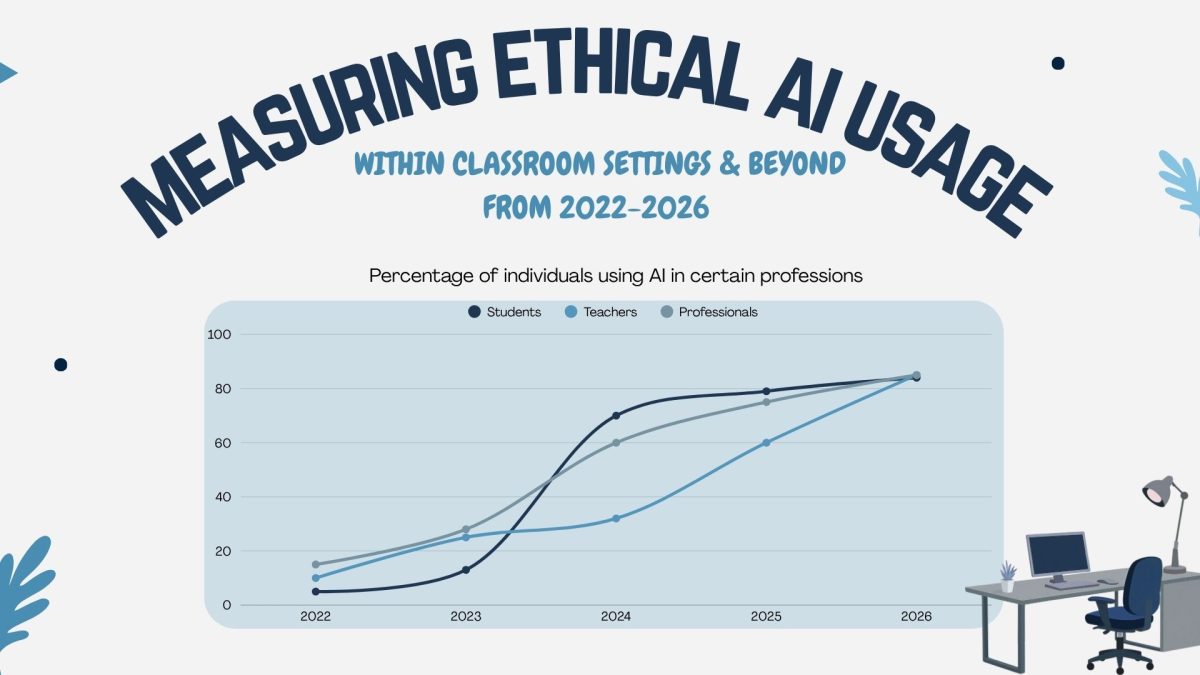
Artificial intelligence, or AI, has fully transformed the way in which society completes both small and large-scale tasks. Through the system’s automation and pattern recognition, daily life has been restructured in a way where cognitive and manual tasks are being replaced, and professionals are gaining a new perspective on the benefits of the new-found application. With this innovative but possibly dangerous technology comes a multitude of risk factors and dangers. As AI and other large language models (LLMs) have gained influence in the education sector, many students, teachers, and administrators have advocated against the models, believing that it has promoted academic dishonesty, reduced social interaction, and diminished intellectual capacity and critical thinking. Because these risks also come with numerous efficiency benefits, navigating AI usage in classrooms has been an especially difficult task for administrators and teachers.
Popularity & Influence:
It is important to understand the context in which AI has grown inside and outside the classroom and ask the question: “Why have AI models gotten so popular?” In the first place, AI models are unlike any technology used before and have supreme capabilities. From improved speed, accuracy, and efficiency, ChatGPT and others are accessible, easy to use, and are scalable beyond other search engines. Professionals and students needing to research a specific topic can often bypass the need to read articles, but instead can appreciate brief, relevant, and accurate summaries of large information datasets. Peter Augros, Mater Dei’s Computer Science teacher, shares his perspective on the growth and benefits of AI usage.
“[AI systems are] new, so people are curious about them [and] want to find out what they do,” Augros said. “Right now, people are using AI to replace Google, but their potential is far beyond that. A small minority of people [actually] know how to use AI in an enhanced way beyond just a search engine. Also, they’re popular because they make your grunt work easy.”
Mirroring other schools, institutions, and education centers, Mater Dei’s students have begun adopting the technology in beneficial ways. Mater Dei has found that the majority of its students make use of AI ethically to brainstorm project ideas, generate outlines, edit essays, and simplify complex topics into smaller and more manageable steps. Not only can these models offer students academic support, many have found it is most beneficial for studying. With its ability to summarize large amounts of information, AI can create comparable practice questions and study guides for students and structured lesson plans for teachers. Augros shares his observances of how both students and teachers use the technology for meaningful practices.
“Chat GPT, for example, is a great tutor,” Augros said. “If you use it as a teacher at home, and you ask it questions for examples, clarification, test questions, and practice, that’s all great use. Teachers are also becoming familiar. It’s a great tool for [us]. It takes care of lesson planning super fast, in a way that I couldn’t do it. It’s great because then I can engineer my classes instead of just getting them ready.”
Dangers:
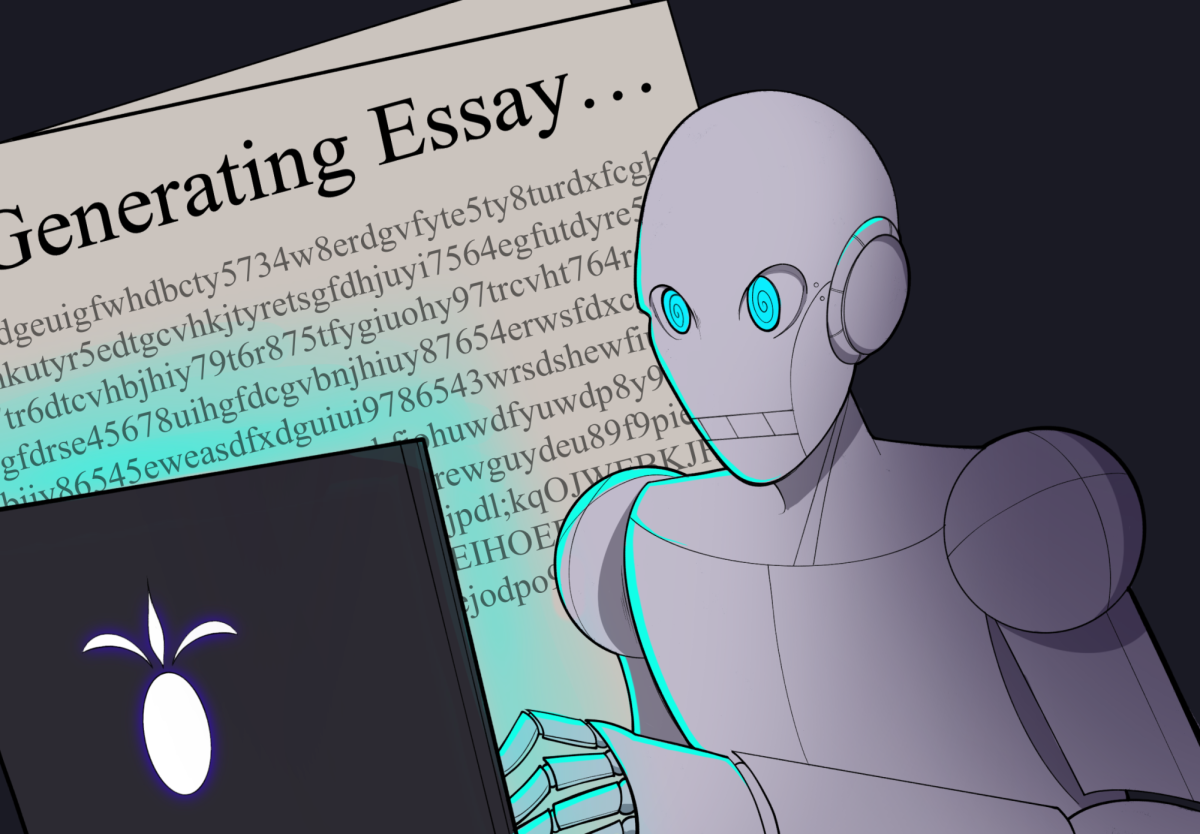
Beneficial technology like AI has increasingly been associated with negative cognitive and moral effects. As models have gained popularity in schools, some students have used them to commit academic dishonesty, especially copying and plagiarizing. As a result of this increase in cheating, many schools have decided to ban this technology without regard for the possible benefits it provides. Mater Dei, however, has treated unethical AI usage the same as direct plagiarism, ensuring consequences for academic dishonesty and using the opportunity as a moral, teaching moment. Executive Director of Educational Technology and Online Learning Samantha Kozak shares her own perspective of the frequent unethical application in classrooms.
“Not everyone is using [AI] appropriately, and it essentially follows our academic dishonesty policy,” Kozak said. “If a student is misusing AI, a teacher is going to follow the same policy as if the student was plagiarizing or citing someone’s work as their own. Depending on the type of assignment, if it’s homework versus a test, there [are] different levels of consequences.”
Studies have also shown that an increased dependence on AI can reduce foundational cognitive skills. When students use their critical thinking skills less within the classroom, they also relinquish their own sense of individuality, and unique opinion. Furthermore, the technology can also negatively affect mental health and personal privacy. As a result of AI reliance, many students turn to chat bots for therapists or digital “best friends”, ultimately decreasing social interaction and allowing large-scale data breaches and bullying. Mater Dei Religious Studies Teacher Jarryd Lagado shares his opinion that AI poses significant dangers to students’ psychological health.
“Not only can [AI] be used for nearly all kinds of school work, writing, researching, and even creating projects and doing math, it can be a tutor and to some it can even be a sort of ‘companion,’” Lagado said. “We had bots in the past that you can ‘talk’ to, but with this version it has the veneer of having its own personality, which I think is what people gravitate to – especially as I’ve discovered many students ‘name’ their AI.”
Mater Dei’s Official Position:
Although many other institutions have resorted to banning or heavily restricting the technology, Mater Dei has empowered both students and teachers to research its potential use and utilize it as an instructional tool. With this resource and its occasional dangers, Mater Dei dedicates itself to teaching students the ways in which the technology should be ethically used. ChatGPT and other models will not be leaving society anytime soon, so Mater Dei and its teachers understand the importance of mastering ways to use it to improve society and drive further efficiency for all students.
“We know AI is here to stay, but we want to insist that academic honesty is paramount to the educational process,” Lagado said. “We, as a faculty, have had several professional development days on the use of AI in the classroom. Like the usefulness of a tool, AI should be used to enhance the teaching style and the learning of the student – not replace either. I think students should learn about AI because it does seem to be the future, especially in technology. Many jobs are going to require its use and it can increase productivity and workflow.”
In this Age of Artificial Intelligence, it is critical that humans prioritize connection, real-world experiences, and relationships with others. At its core, AI is just an educational tool. Studies have shown that AI companionship has negative effects on mental health and can increase feelings of isolation and loneliness. With that in mind, it is crucial that students involve themselves in connection and learn interpersonal skills, as AI can never teach creativity, perseverance, emotional intelligence, and rationality. Most importantly, if humanity relies on technology to the greatest extent, we can lose who we are and the fundamental building blocks of human individuality and consciousness.
“AI can teach you facts and pretend to be a companion, but it can’t replace the relationships that you build with your peers [at school] or with your teachers, staff, and coaches,” Lagado said. “As we move forward as a society, I believe we will need community and human interactions more than ever, something that AI can never replace.”
![GET UP Students laugh and dance at a school rally. All the events and rallies hosted by ASB help bring students together and make school an enjoyable place to be. Senior Maddy O’Connor believes ASB keeps everything together and the school spirit alive. “A lot of things wouldn't be as organized [without ASB] and it'd be kind of boring,” O’Connor said. “ASB brings joy to Mater Dei, and pretty much [all things] cool.”](https://thescarletscroll.com/wp-content/uploads/2026/05/HEIF-Image-1200x800.jpeg)
![OUT OF THE PARK Sophomore Ally Roman takes a swing during her sixth game of the spring season. On Wednesday, Mar. 18, the JV softball team faced Villa Park in a tough matchup. “ I've made a lot [of sacrifices for softball],” senior Savanah Duncan said. “It takes up a lot of time, especially playing at a high level. I would say you have to sacrifice a lot of your time and a lot of outside activities, because a lot of time is just spent on the softball field.”Photo courtesy of Ali DePhillips.](https://thescarletscroll.com/wp-content/uploads/2026/04/HEIF-Image-10-800x1200.jpeg)







![GAME ON The Mater Dei Esports Team competes against each other. The Esports team competes not only against each other but also against many other schools. They compete by playing popular video games like Valorant, Super Smash Bros, and Fortnite. Jimenez and his teammates support the ongoing gaming legacy in hopes of keeping it strong in the future. “Ultimately, [I coach] because of my love for video games, and my passion for having an opportunity to be part of a team,” Jimenez said. Photo courtesy of Paloma Navaro.](https://thescarletscroll.com/wp-content/uploads/2026/01/HEIF-Image-2-1200x900.jpeg)

![AN AI FOR EDUCATION
Sophomore Sofia Rudolf scrolls through Magic School AI’s many features. Rudolf enjoys using tools such as the writing feedback option, in order to gain a new perspective on her work. “I do like the writing feedback [tool],” Rudolf said. “It gives you good input to help elaborate on some stuff.”](https://thescarletscroll.com/wp-content/uploads/2025/02/IMG_1752-1200x676.jpeg)